

There is A LOT of doom and gloom to go around. Domestic and international violence. The economy and inflation. It feels like everything is falling apart. And while these are wildly unprecedented times for our country, we have seen a lot of this before—just not everything, everywhere, and all at once. The nonprofit sector specifically has also weathered storms in the past. And we can pull out learnings and build tools needed to make it through everything being thrown at us right now.
We can also get good advice from unexpected sources. In fact, by tuning into that “oldies” station or playlist you may hear a song, from way back in 1978, that sheds a light on the path forward. That song is, The Gambler, by Kenny Rogers.
As the song explains, the key to success (in life and poker) is understanding the cards you’ve been dealt and figuring out how to make the best use of them:
“You got to know when to hold ‘em.
Know when to fold ‘em.
Know when to walk away.
And know when to run.”
- Kenny Rogers, The Gambler
Similar to the gambler in the song, in order to make the right decision right now, you need to look at the entire game—both from a table level view as well as from a bird’s eye view. You have to understand past actions and learn from them to better predict future outcomes.
So, the question you have to answer is, “Are you living in the now, or is your decision making rooted in historical data?”
Where We’ve Been
While this timeline is decidedly unique, we’ve had similar financial upheavals and philanthropic reshuffling and pulling back in the past. During those times, many nonprofits faced budget crises, scaled back their work, fired multiple staff, and several even closed their doors:
After September 11, 2001
During the Great Recession of 2008
During and “after” the International Covid Pandemic of 2020 (and beyond)
Amidst those turbulent times, we’ve also had “surge” moments—where individual giving dramatically increased—including:
After September 11, 2001
After the 2016 Presidential Election
During the Movement for Black Lives after the murder of George Floyd in 2020
After the Dobbs SCOTUS decision in 2022
Many organizations that faced crises, surges, or both, struggled. They used outdated modes of communication—and often didn’t communicate at all. They believed that “keeping a stiff upper lip” and not letting the public “see you sweat” was the best way to convey strength. They thought they knew what people wanted to hear from them, yet they never asked, or looked at the information that was screaming at them from within their own data. They even, unintentionally, positioned their organization as more important than their mission by speaking to the importance of keeping their doors open rather than keeping the work going.
What We Did Then
The organizations that survived took a different approach. They centered their mission, vision, and values. They communicated frequently with their people—all of them. They used every channel they had available. They were transparent. They talked about money. They talked about people. They used language that connected (lots of “I, you, and we”).
When these nonprofits talked about how the financial climate impacted them, they centered the people they served, not their own jobs or existence. They also gave people multiple opportunities and options to do something—making monetary and nonmonetary asks alike. In short, they pulled back the curtain and told the truth, and through that, they embraced the community that had been there for them, and laid the groundwork to expand it by communicating in a way that nurtured authentic relationships.
And what happened in those times when donations surged?
When those donors were welcomed and engaged with in the same way, many of those donors stayed. When they weren’t, they never returned.
Where We Are Now
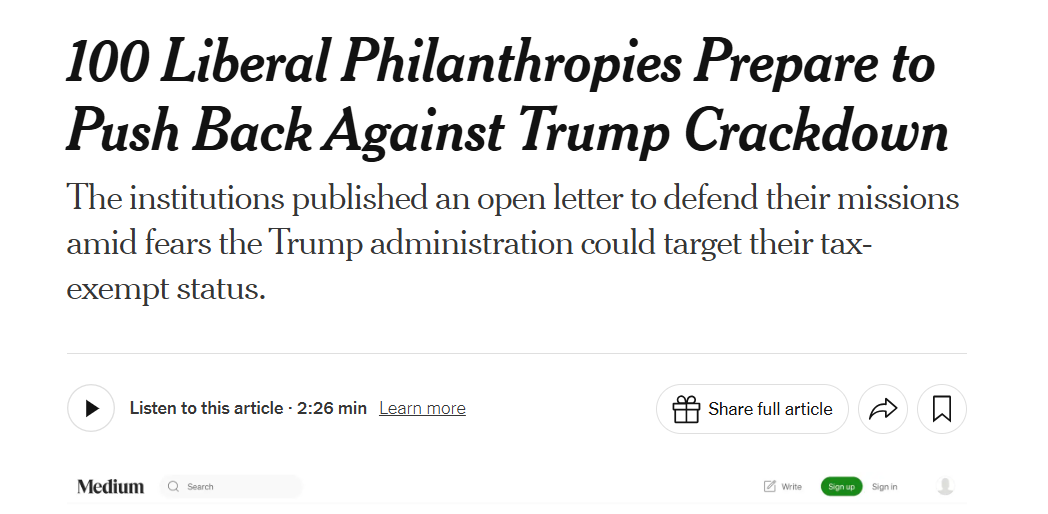
The DOGE cuts from early 2025 had a devastating effect. The nonprofit sector saw its funding gutted, long standing agencies were dismantled, staff were terminated, and the aftermath was lots and lots of chaos. Organizations that depend on federal grants had to slash programs, services, and staff, all while the need for those services increased. And while DOGE may, ostensibly, be gone, the administration is still expanding on what they started. They are still attacking the nonprofit sector and the main targets are progressive and leftist organizations. And all of this has had a trickle down effect.
Many government funded organizations scrambled to fill their funding gaps with foundation grants—making an already competitive environment even more so. Major funders, especially in the civic engagement space, announced spend downs, or have transitioned out of this space. The federal government’s threats to funders related to their funding practices resulted in foundation and corporate funders trying to hide from the spotlight by complying in advance, shifting funding priorities and even clawing back grants. And, specifically, running away from anything that sounds like diversity, equity, and inclusion.
The sad truth is that philanthropy had been navelgazing since the 2024 election and was too slow to respond to emerging threats. Funders began to stand up to the administration, not when it began targeting nonprofits, but only after facing direct attacks themselves, putting their endowments before the social contract.
BIPOC, immigrant, and LGBTQ+ communities are living in fear of harassment and state violence. The economy is precarious. Everyday life is getting more expensive because of tariffs and government actions. Hundreds of thousands of people have lost their jobs—and most disturbing is that 300,000 of them are Black women! People are hurting. And, because of all of this, it appears that more people are holding onto their money.
But there is hope. Even with the decline in the number of people donating, we are seeing an increase in the average size of individual donations. That means that the people with the means, desire, and opportunity are stepping up.
What We Can Do Now
You are not navigating economic uncertainty alone. Your donors, staff, and board members are experiencing similar pressures. Take the lessons from the past and apply them. Immediately. Focus on people: the people you serve and the people who care about your work. Invite them into the conversation. Be transparent about both challenges and opportunities.
When you communicate, make sure that your mission, your work, and your impact take center stage. Keep your vision and values visible. Be clear and candid—especially about finances—and explain how funding shifts affect real people and real outcomes. Stay in regular contact with your whole community: donors, prospective donors, volunteers, advocates, activists, partners, and stakeholders. Use every channel available—in the way it was designed to be used. Avoid jargon and insider shorthand. Don’t write tomes. These folks are your friends. Talk to them that way and give them something to do.
The principles are similar for individuals and institutions, though tactics may vary. When dealing with institutional funders, pay close attention to how the current climate impacts how you present your work. Meaning, you may have to code switch.
Many foundations—and particularly government entities—are using automated tools to screen submissions, rejecting projects with language that triggers heightened scrutiny. To mitigate this, you will need to fly under the radar. Your work doesn’t need to change, but the way you describe it may. Frame your work in ways that are accurate, grounded, and strategic. Emphasize outcomes, distinct expertise, and the specific value you bring. Make a clear case for why you are uniquely positioned to deliver results. And most importantly, invest in relationships with program officers and fund managers wherever possible. Direct relationships can provide context that forms alone cannot.
Nestled between individual donors and institutional funders are Donor Advised Funds (DAFs). It is expected that they will continue to grow as a share of giving in 2026, so it is essential that you prepare. It’s estimated that 80% of DAF donors are already giving to the organizations they supported with a DAF gift. Be proactive by sending a short 1-question survey to all of your people asking if they have DAFs. Promote that you’re DAF friendly on your website. Encourage donors to notify you when they initiate a gift through their DAF. And finally, create a DAF giving society to encourage donors to out themselves.
Scarcity thinking can not only make people cautious about giving, it also creates unnecessary competition among partner organizations. This is not the time to run from collaboration, it’s an opportunity to run toward it. Identify and create collaborative fundraising opportunities. Strategic partnerships can expand the reach of all organizations involved, introducing each to new friends and funders, strengthen funding proposals, and create cost efficiencies by sharing both the effort and the expense.
Final Thoughts
While unique, this is not the first difficult time nonprofits have faced. Funding priorities change. Political winds shift. The attention of the general public drifts and then returns. This is not the time to panic, or hide. It’s time to assess, learn, adjust, and move forward with purpose. If your decisions are driven only by the urgency of this moment, they will likely be reactive. If they are informed by experience—by patterns we’ve seen from past cisises—they can be strategic.
The goal is not simply to survive this moment. It is to navigate it in a way that strengthens your organization for what comes next.
For tools to tackle the new fundraising landscape, join the Growth Forum.